
The Winzerstube
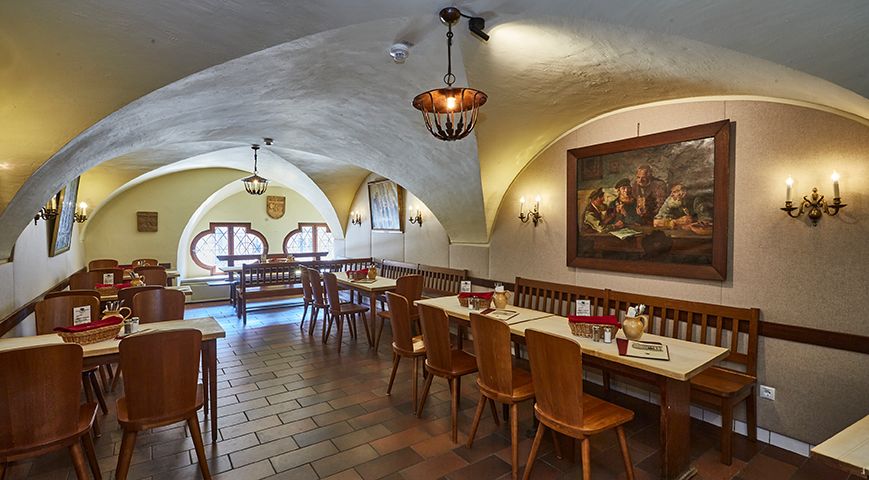
A painting by the Palatinate ‘winegrower’ painter Gustav Ernst (1858 – 1945) depicting winegrowers drinking adorns the smallest room.
The winegrowers hold in their hands or have in front of them the typical ‘Dubbe’ wine glasses, which hold the equivalent of a
Palatinate Schoppen (= 0.5 l).
Gustav Ernst – The Vintner Painter
A native Saxon became the painter of the Palatinate soul. Gustav Adolf Ernst (1858–1945) came from Elsterberg in the Vogtland region, son of a weaver, and found his way to the Palatinate by roundabout paths. After attending the School of Applied Arts in Munich, he worked for three decades as a decorative painter in various cities – Munich, Zurich, Mannheim, Nuremberg. But from 1902, he had a studio in Bad Dürkheim, and here he discovered his true subject: the vintners of the Palatinate.
Ernst did not paint idealized landscapes, but people. Bearded men with weather-beaten faces, sitting together after a day’s work in the vineyard. Cheerful revelers at the Wurstmarkt, merry with wine and content. His paintings captured what makes the Palatinate special: the connection between hard work and carefree joie de vivre, between tradition and conviviality. In 1913, he bequeathed his most important works to the Dürkheim Vintners’ Association as “inalienable property” – they were to remain where they belong.
The “Vintner Painter,” as he was called, returned to Bad Dürkheim in 1934 and lived there until his death in 1945. His motifs became postcards and advertising stamps for the Wurstmarkt, the world’s largest wine festival. A street in Bad Dürkheim is named after him. The painting in this room shows carousing vintners with the most typical of all Palatinate drinking vessels in their hands: the Dubbeglas.
The Dubbeglas – Palatinate Cult in Half-Liter Format
“De Dorscht, der macht erscht richtig Spaß, hoscht so e Pälzer Dubbeglas” – “Thirst only becomes real fun when you have a Palatinate Dubbeglas,” the folk saying goes. What the Maß beer mug is in Bavaria, the Dubbeglas is in the Palatinate: a cultural treasure that goes far beyond its practical use. The conical glass with its characteristic round indentations – the “Dubbe,” Palatinate dialect for dots – holds half a liter and is indispensable at every wine festival, every Straußwirtschaft tavern, and every convivial gathering.
Legend has it that clever Dürkheim butchers invented the glass. At slaughter feasts, the smooth wine glasses slipped too easily from greasy hands – the worked-in dimples solved the problem. In fact, the history goes back further: as early as the 4th century, the Romans knew similar glasses with applied dots, as finds from Gönnheim prove.
The Palatinate Schoppen of half a liter is sacred to Palatines. When Napoleon tried to introduce smaller glasses, he failed against the stubbornness of the locals. When restaurateurs wanted to reduce the Schoppen to 0.4 liters in 1984, successful resistance formed – documented in the stone Schoppen Monument of Maikammer. That everyone in a convivial round shares one glass, passing it from hand to hand, is not a makeshift solution but lived tradition: wine is not drunk alone.
In the smallest room of the Pfälzer Weinstube, the vintner painter and the vintner’s glass unite into a picture of Palatinate lifestyle – that uncomplicated joy of a good drop that Gustav Ernst captured so aptly.