
The Sickingenstube
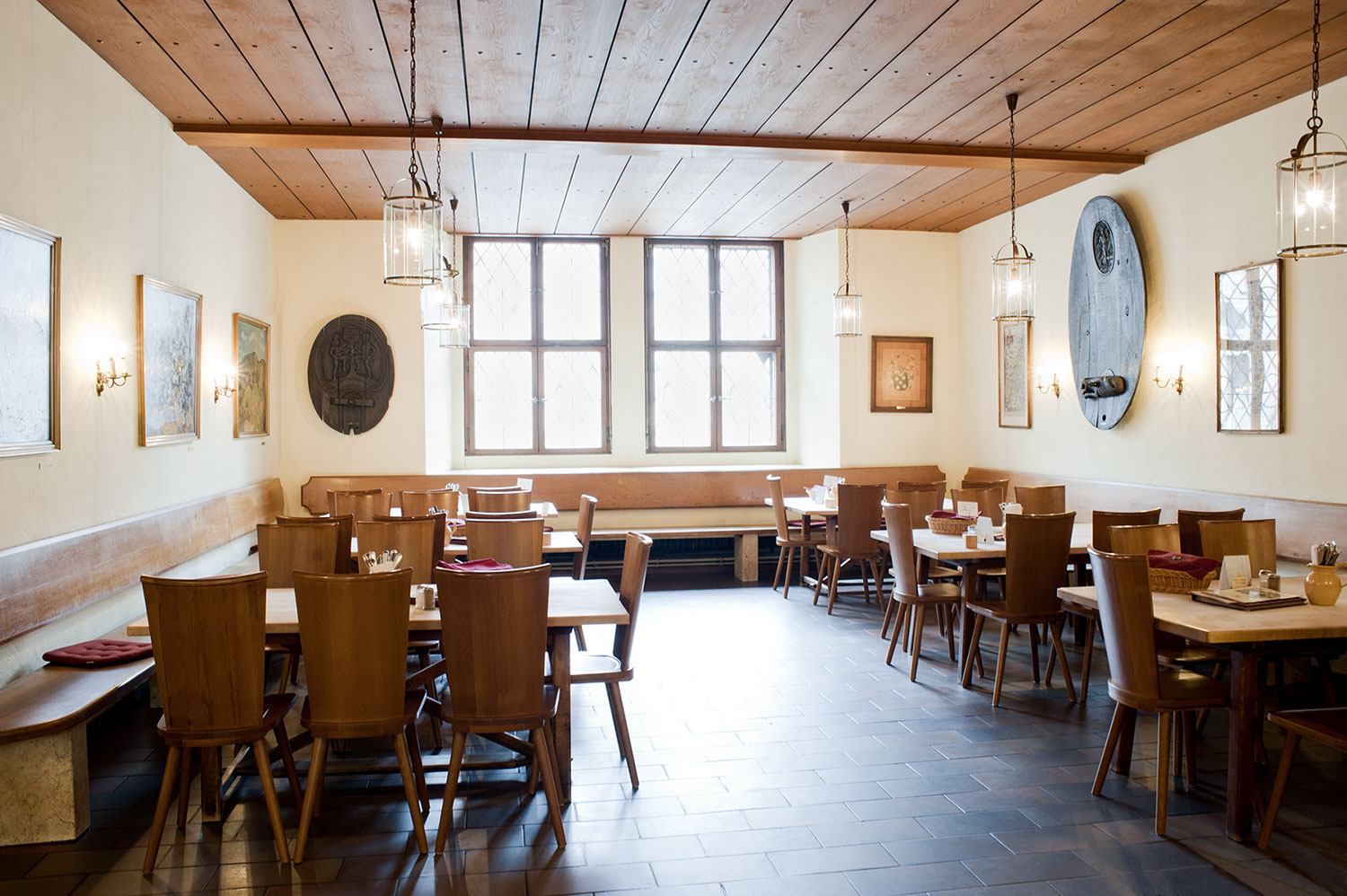
This room commemorates the rebellious Palatinate imperial knight Franz von Sickingen (1481–1523). He supported the followers of the Reformation, clashed with the Emperor and the Church, and was fatally wounded during the bombardment of his castle Nanstein. The paintings by Speyer artist Karl Graf (1902–1986) in this room depict the history of Sickingen.
Franz von Sickingen – The Last Knight
Franz von Sickingen was a man caught between eras. Born in 1481 at Ebernburg Castle on the Nahe, he witnessed the decline of free knighthood. He was no romantic knight, but an entrepreneur of violence – with his mercenary armies he waged feuds against cities and princes, extorted ransoms, controlled trade routes. At one point, Emperor Charles V owed him nearly 100,000 guilders.
In 1519, he met Ulrich von Hutten, the humanist seven years his junior, who opened his eyes to a greater vision: the reformation of the Church, the renewal of the Empire under the leadership of the free knighthood. Sickingen turned his castles into refuges for persecuted reformers. Martin Bucer, Johannes Oecolampadius and Caspar Aquila found shelter here. Hutten called Ebernburg the “Inn of Justice”. Within its walls arose the third Protestant congregation of the Old Empire – after Wittenberg and Nuremberg.
In September 1522, Sickingen made his bold move: he marched against the Archbishopric of Trier, intending to overthrow the Elector and secularise the Church’s holdings. But a cross-confessional coalition of princes formed against him. After just a few weeks, he was forced to abandon the siege and retreat to his strongest fortress: Nanstein Castle near Landstuhl.
In spring 1523, the allied armies advanced on Nanstein – bringing the largest artillery force of that era. Over 600 cannonballs are said to have rained down on the castle in a single day. After just two days, Sickingen’s supposedly impregnable fortress lay in ruins. On 1 May 1523, he was gravely wounded behind an embrasure. “Though the stones have struck me a little, it does me no harm,” he reportedly said. On 7 May 1523, he died. Contemporaries saw his death as symbolic: German knighthood had perished.
Karl Graf – Painter of History
The paintings in this room are by Karl Graf (1902–1986), the “Painter of the Palatinate”. After training in Nuremberg and study trips to Italy, he found his artistic home in the Palatinate. As founding member and long-serving chairman of the Palatinate Artists’ Cooperative, he shaped regional artistic life for decades.
Graf’s working method was classical: first came sketches en plein air, capturing composition and light. In the studio, these became large-format paintings with his unmistakable, almost abstracted brushwork. His wine motifs served for years as templates for award certificates. For his life’s work, he received the Order of Merit First Class and the Max Slevogt Medal.
When Graf took up historical subjects like Franz von Sickingen, he did so not as a bombastic history painter. His paintings of castle ruins show the landscape as it is: the ruins as part of nature, overgrown, weathered. And yet they tell history. In Graf’s pictures, one senses that these stones witnessed great upheavals – the end of an era, when cannonballs shattered the walls of Nanstein.
In this room, Graf’s works hang like visual commentaries on history: they show not the battle, but the aftermath – the calm after the storm, the landscape that has outlasted all conflicts. History is present, but not intrusive. It hovers in the room like the memory of a rebellious knight who dared too much, and of a world that perished with him.