
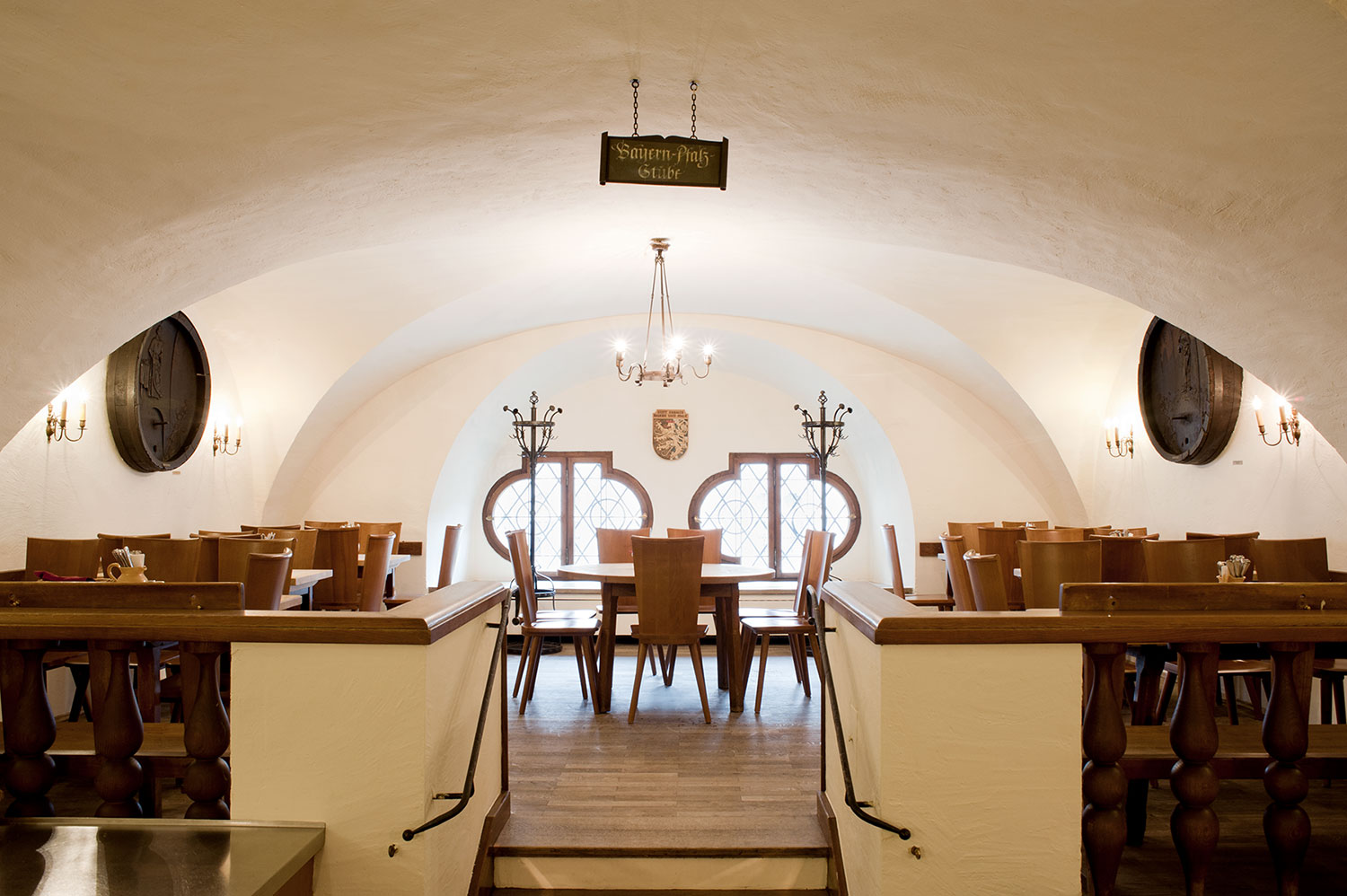
The Bavaria-Palatinate Room
For over 700 years, from 1214 to 1945, the Palatinate and Bavaria formed a dynastic or political union. After 1945, the Regional Association of Palatinate People in Bavaria, whose board runs the wine bar, joined forces with the Bavarian state government to launch a referendum to reintegrate the Palatinate into Bavaria. This referendum failed in 1956. Since its foundation in 1950, the ‘Pfälzer Residenz Weinstube’ has been a flagship for Palatinate wine and the Palatinate way of life in the Bavarian capital.
This is commemorated in this room, which features paintings by contemporary Palatinate artists Michael Heinlein and Dirk Klose with Palatinate motifs.
700 Years of Shared History
On October 6, 1214, Duke Ludwig I of Bavaria – known as “the Kelheimer” – was enfeoffed with the County Palatine of the Rhine by the Staufer Emperor Frederick II. From that day forward, all Wittelsbachs bore the proud double title “Count Palatine of the Rhine and Duke of Bavaria.” Two regions, one dynasty – this bond would endure for over seven centuries.
The House Treaty of Pavia divided the Wittelsbach inheritance in 1329 into a Bavarian and a Palatinate line. Yet a prophetic clause remained: should one line die out, the other would inherit everything. When the last Bavarian Wittelsbach died without heirs in 1777, this rule came into effect. The Palatinate Elector Karl Theodor reunited both territories – after 448 years of separation.
From 1816 onward, the Palatinate belonged to the Kingdom of Bavaria as the “Rhine District.” King Ludwig I loved the region so much that he compared it to his beloved Italy and had the Villa Ludwigshöhe near Edenkoben built as his summer residence. The Hambach Festival of 1832, when 30,000 people demonstrated for freedom and unity, became a symbol of democratic hope in the Bavarian Palatinate.
This 130-year union ended abruptly in 1946 – not by the will of the people, but through French occupation policy. The Palatinate became part of the newly created Rhineland-Palatinate. In 1956, a referendum for reunification with Bavaria narrowly failed: only 7.6 percent voted in favor instead of the required ten percent. The Association of Palatines in Bavaria, which had campaigned for reunification since 1949 and founded this wine tavern in the Munich Residence in 1950, keeps the connection alive to this day.
Michael Heinlein – Romanticism and Homeland
The Speyer painter Michael Heinlein (1953–2019) embodied the artistic bridge between Bavaria and the Palatinate. Born in his hometown, he studied at the Academy of Fine Arts Munich and became assistant to the Fluxus artist Robin Page. The dramatic, dreamlike landscapes of the late Munich Romantics shaped his work – particularly those of his namesake Heinrich Heinlein from the 19th century.
His unique technique of painting over postcards transformed historical postcards of Speyer and cathedral views into something timeless. From the Villa Ludwigshöhe, he painted views of the wine village of Rhodt; his “Heinrich Prospekt” on Emperor Henry IV’s crossing of the Alps was exhibited at the Historical Museum of the Palatinate. A fellowship at the Villa Romana took him to Florence, yet the Palatinate always remained his artistic center. After his death, his friend Klaus Fresenius founded the Fresenius-Heinlein Foundation, which today supports Palatinate artists with travel grants.
Dirk Klose – The Living Bridge Builder
The artist Dirk Klose, born in Frankenthal in 1965 and raised in Speyer, has lived in Munich since 1989 – and is the personified connection between both regions. He studied art history at Ludwig Maximilian University, earned his doctorate on Leo von Klenze, and simultaneously completed his art studies at the Academy of Fine Arts Munich.
Since 1999, Klose has managed the office of the Association of Palatines in Bavaria; since 2014, he has been editor-in-chief of the magazine “Die Pfalz.” His artistic work – painting on wood with gold ground and silver aluminum – revolves around themes such as environmental destruction and critical materialism discourse. The series “Shattered Butterflies” and “Black Earth” show endangered butterfly species and Amazon rainforest fragments on gleaming backgrounds – a contrast between materialistic veneer and threatened nature.
In this room, history and present unite: 700 years of dynastic entanglement, a separation forced by great power politics, and two artists as living witnesses of a bond that has outlasted all political borders. The Palatinate lion in the Bavarian coat of arms still reminds us today that what was once separated belongs together.