
The Domstube
Speyer Cathedral recalls the Palatinate’s great era in the Middle Ages, when the Salian emperors from Conrad II to Henry V ruled the region and built the cathedral as their burial place.
It is the largest Romanesque cathedral north of the Alps.
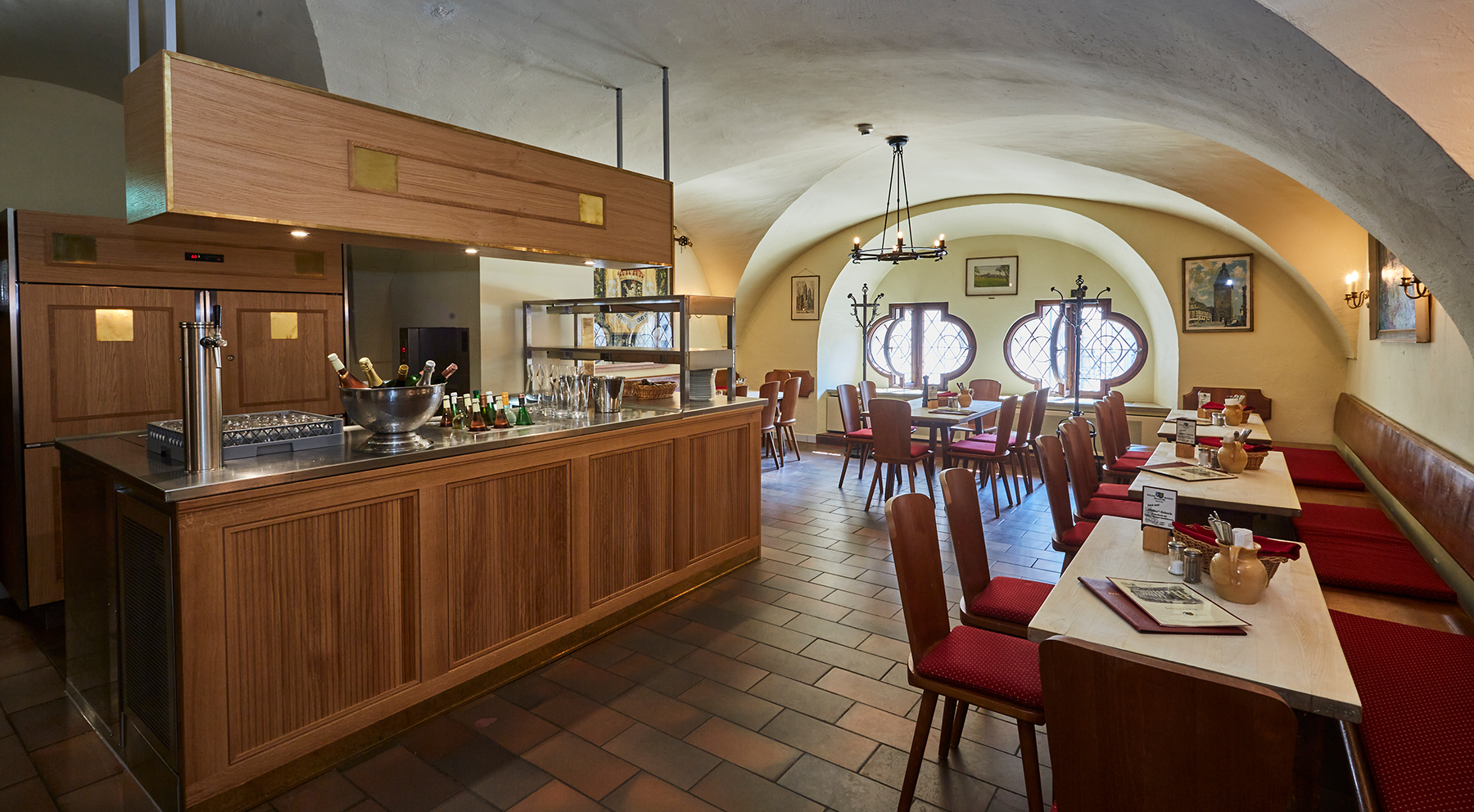
A painting by Speyer artist Karl Graf in this room shows the cathedral from the Rhine side.
The Imperial Cathedral – Symbol of Salian Power
When Conrad II ordered the construction of a new cathedral in Speyer around 1025, he had a monumental goal: to build the largest church in Christendom. The Salian emperor, who hailed from the region between Worms, Speyer and the Nahe, intended this edifice to demonstrate his God-given power – a stone manifesto of imperial ambition, surpassing all previous church buildings.
Conrad II himself did not live to see its completion. When he died in Utrecht in 1039, the cathedral was still a vast construction site. His body was brought to Speyer and interred in the nave before the high altar – in an iron burial chest, as the crypt was not yet finished. With him began a tradition: the cathedral became the burial place of the Salian emperors. Neither his son Henry III nor his grandson Henry IV saw the completed building – it was only in 1061, under the third Salian ruler, that the cathedral was consecrated.
Yet Henry IV was not satisfied with what had been achieved. In 1080, he had half the cathedral torn down to rebuild it larger and more magnificent still. The nave was raised by five metres; for the first time in architectural history, the structure received a continuous dwarf gallery and blind arcade system. At 134 metres long and 33 metres wide, the cathedral grew into the largest Romanesque church – a title it holds to this day, since the Abbey of Cluny was partially destroyed during the Napoleonic era.
The crypt, the finest and largest of the Middle Ages, extends beneath the entire choir and transept. Here rest four Salian emperors – Conrad II, Henry III, Henry IV and Henry V – along with two empresses and over forty bishops. After the Salians, Hohenstaufen and Habsburg rulers also chose the cathedral as their final resting place. It became the most important royal and imperial burial site in Germany – comparable only to Westminster Abbey in London.
The position of the graves is symbolic: at the end of the nave, on the threshold between the “earthly” space and the “sacred” crossing, between life and eternal life. At the latest with the burial of the first non-Salian ruler, it became clear: the cathedral was not merely a family tomb, but a monument to the continuity of emperorship and kingship itself.
Since 1981, Speyer Cathedral has been a UNESCO World Heritage Site – only the second German monument to receive this distinction. It has survived wars, fires and revolutions. In 1689, the War of the Palatine Succession destroyed more than half of the nave; the French Revolution devastated its furnishings. In 1806, it nearly faced demolition. Yet it stands. A thousand-year testament to Salian self-confidence, still the largest preserved Romanesque church in the world.
Karl Graf – The Cathedral on the Rhine
The painting in this room shows the cathedral from the Rhine side – a view that never ceased to fascinate Karl Graf. The Speyer painter, who lived from 1902 to 1986, was a chronicler of his home city. In his works, the cathedral appears not as a tourist motif, but as a living part of the landscape along the Rhine.
Graf painted the cathedral in different seasons and lighting conditions. His working method was consistent: first he would sketch en plein air, capturing composition and light. In the studio, paintings emerged with his characteristic, almost abstracted brushwork – a style that captured the monumentality of the building without lapsing into pathos.
In this room, the history of the Salians merges with Graf’s quiet contemplation: the cathedral that once proclaimed the emperors’ claim to power becomes a silent witness to a thousand years of history. From here, on the Rhine, it was for centuries the visible centre of secular and spiritual authority. Graf shows it from the perspective of the present – as what it is today: a monument that has outlasted all struggles.