
Historic Entrance Hall to the Imperial Guest Chambers
The Viersäulensaal on the ground floor of the Imperial Wing is far more than a historic entrance hall—it stands as a stone testament to the bond between the Bavarian Wittelsbachs and the Palatinate Wittelsbachs. Its four supporting columns not only bear the weight of the magnificent imperial guest chambers above, but today also symbolize the bond between the Palatinate and Bavaria, a bond shaped by both war and peace.
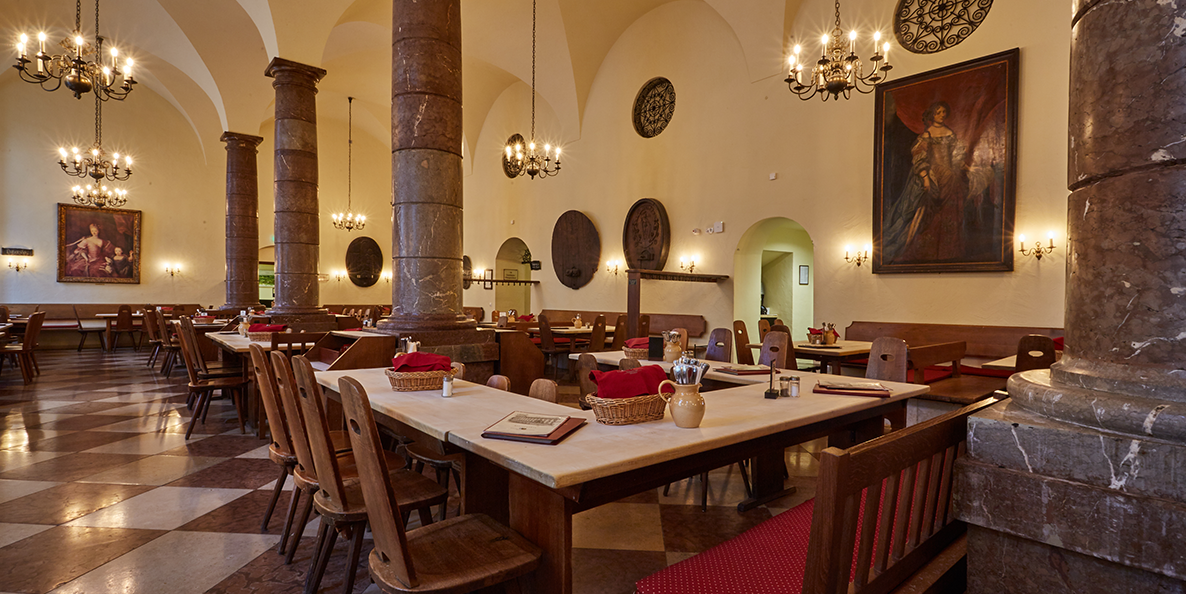
Historic entrance hall to the former ducal guest rooms in the stone room wing of the residence.
This room was built between 1611 and 1619 during the most ambitious construction program at the Munich Residence under Duke Maximilian I of Bavaria. It served as the main entrance to the most exclusive guest apartments in the entire empire—the legendary Stone Rooms on the first floor, which were reserved for the Holy Roman Emperor and his consort. Since 1970, the Four Pillars Hall has been home to the Pfälzer Residenz Weinstube, thus uniquely combining its historical function as a reception hall with the culinary traditions of the united Wittelsbach territories.
A Space Between History and the Present
The Munich Residenz sustained catastrophic damage from bombing raids in March and April 1944. The Stone Rooms above the Hall of Four Columns were completely destroyed. However, the palace administration had acted with foresight: most of the movable works of art had been moved to safe locations before the bombings.
In May 1945, the monumental reconstruction began under the direction of Professor Rudolf Esterer and Professor Otto Meitinger.
The Viersäulensaal on the ground floor, which had largely survived the bombings, was also rebuilt. The historic checkerboard pattern of the floor, with its individually numbered tiles, was carefully restored, and the high vaulted ceilings and the four columns that give the hall its name were reconstructed. In 1950, a wine bar was opened, initially in a different room — the Single-Column Hall. In 1970, due to high demand, the Pfälzer Weinstube moved to the larger Four-Column Hall.
The decision to establish a Palatinate wine tavern in this historic space is more than just a culinary choice—it is a tribute to the reunification of Bavaria and the Palatinate under Elector Karl Theodor in 1777, following 448 years of separation since the Treaty of Pavia in 1329. The Hall of Four Columns is thus a palimpsest of history: Early Baroque columns, wartime destruction, postwar reconstruction, and contemporary use all coexist in a space that has welcomed visitors for over 400 years—once as the threshold to Europe’s most exclusive guest chambers, today as a place of Palatinate-Bavarian hospitality.